





 Cihat Murat Yüksel
14 min read
Contents 13 sections
Key takeaways
- A slogan is a short, striking phrase that expresses an idea and is easy to remember and repeat.
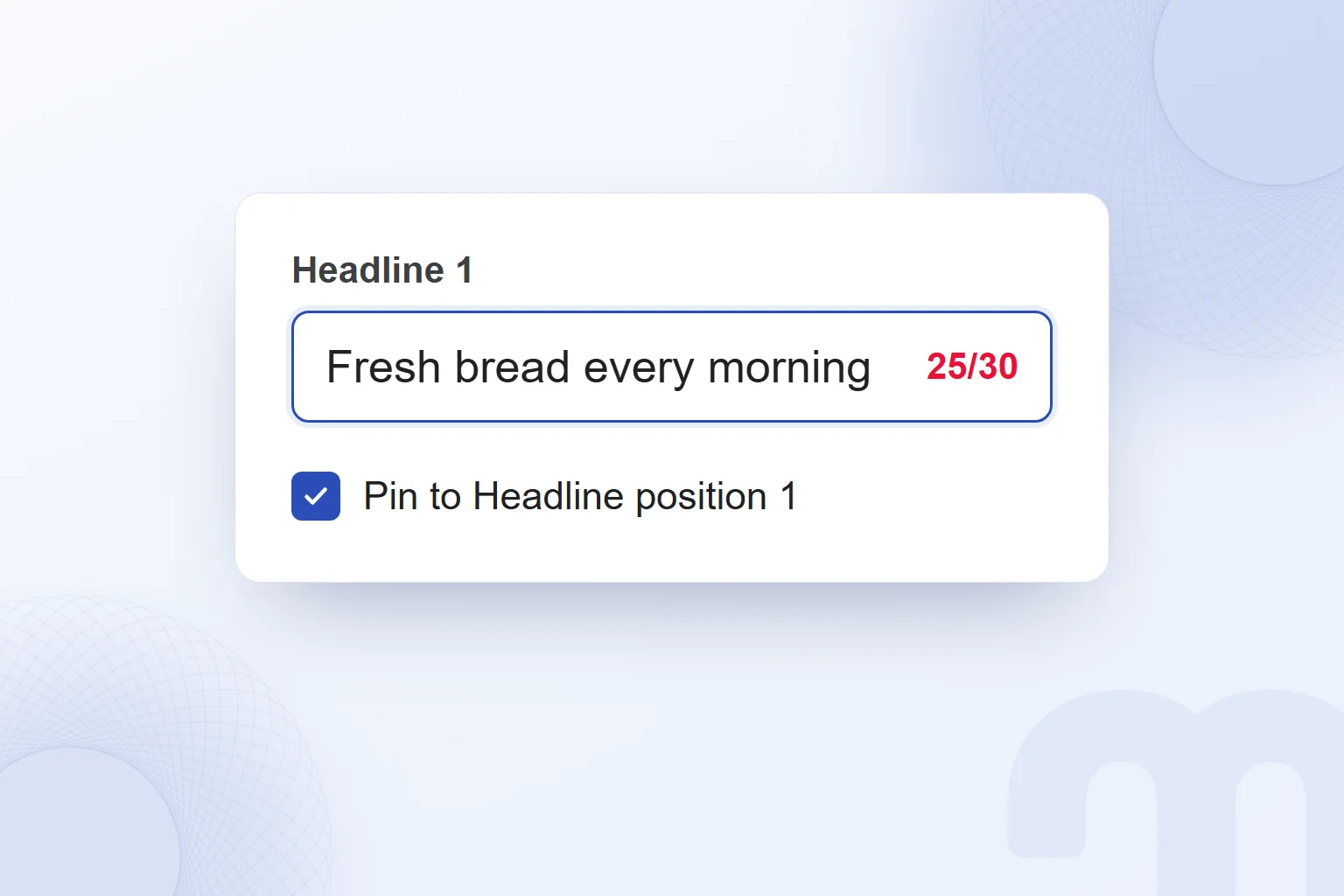
- Google Ads Help states that a responsive search ad headline can be up to 30 characters.
- Turkey's Industrial Property Law No. 6769 protects a registered trademark for 10 years, renewable in ten-year periods.
- A slogan promotes an idea or product, while a tagline makes a company or its products recognizable.
A slogan is a short, striking phrase that expresses an idea or a brand in a way people can easily remember and repeat; the lasting signature line a brand uses in its ads to introduce itself or its products is called a .
We start from the brand’s promise. Instead of squeezing every feature into one line, we pick the promise customers should remember, then check that it matches what the business does, is understood aloud and fits its space. We shorten the words while keeping the claim true.
A slogan is reduced to a single promise, and that promise is checked to be true and provable.
What does slogan mean?
A slogan is a short, striking phrase that expresses an idea and is easy to remember and repeat. The first sense in the Turkish Language Association (TDK) dictionary brings these qualities together.
The second TDK sense is a saying that sums up the aims and means of an identity, community, organization or institution, so a slogan is not limited to advertising.
For a brand, we tie these senses to a purpose: in a campaign, which side of the product to talk about; for the brand as a whole, which promise to sustain. A bakery’s morning baking and an organization’s working principle need different sentences, so we write down the phrase’s job first.
What is the difference between a slogan, a tagline and a motto?
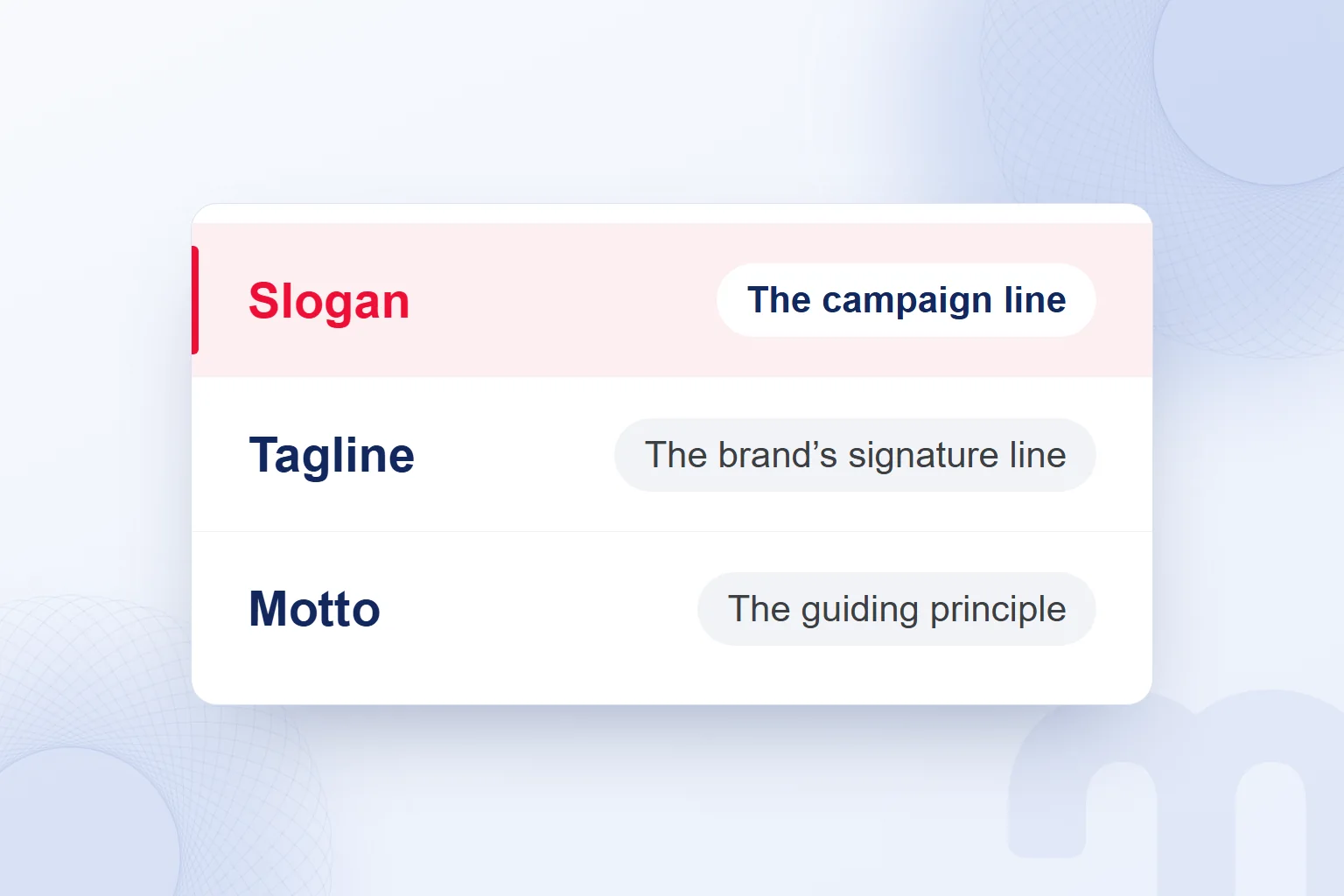
A slogan promotes an idea or a product, a tagline makes a company or its products recognizable, and a motto expresses a belief or principle. Cambridge Dictionary’s three definitions share one feature, a short phrase; what separates them is the job it does.
Cambridge’s tagline definition focuses on a company being recognized in its ads, especially on television and the internet. A motto expresses the beliefs, aims and principles of a person, group, country or organization.
| Phrase | What it expresses | Where it is used |
|---|---|---|
| Slogan | An idea or a product, in a short, memorable phrase | Advertising and campaigns |
| Tagline | A short phrase that makes a company or its products recognizable | In ads, especially on television and the internet |
| Motto | The belief or principle of a person or organization | The organization’s principles and identity |
The TDK dictionary pairs motto with the maxim: a short, firm saying, usually by a known author, that expresses a thought, feeling or principle.
In English, slogan and tagline are often swapped. In a presentation we do not choose the word by dictionary sense alone; we also state the phrase’s job. Presenting a campaign line as the brand’s permanent signature blurs its purpose; where and why a sentence is used decides its heading.
What makes a good slogan?
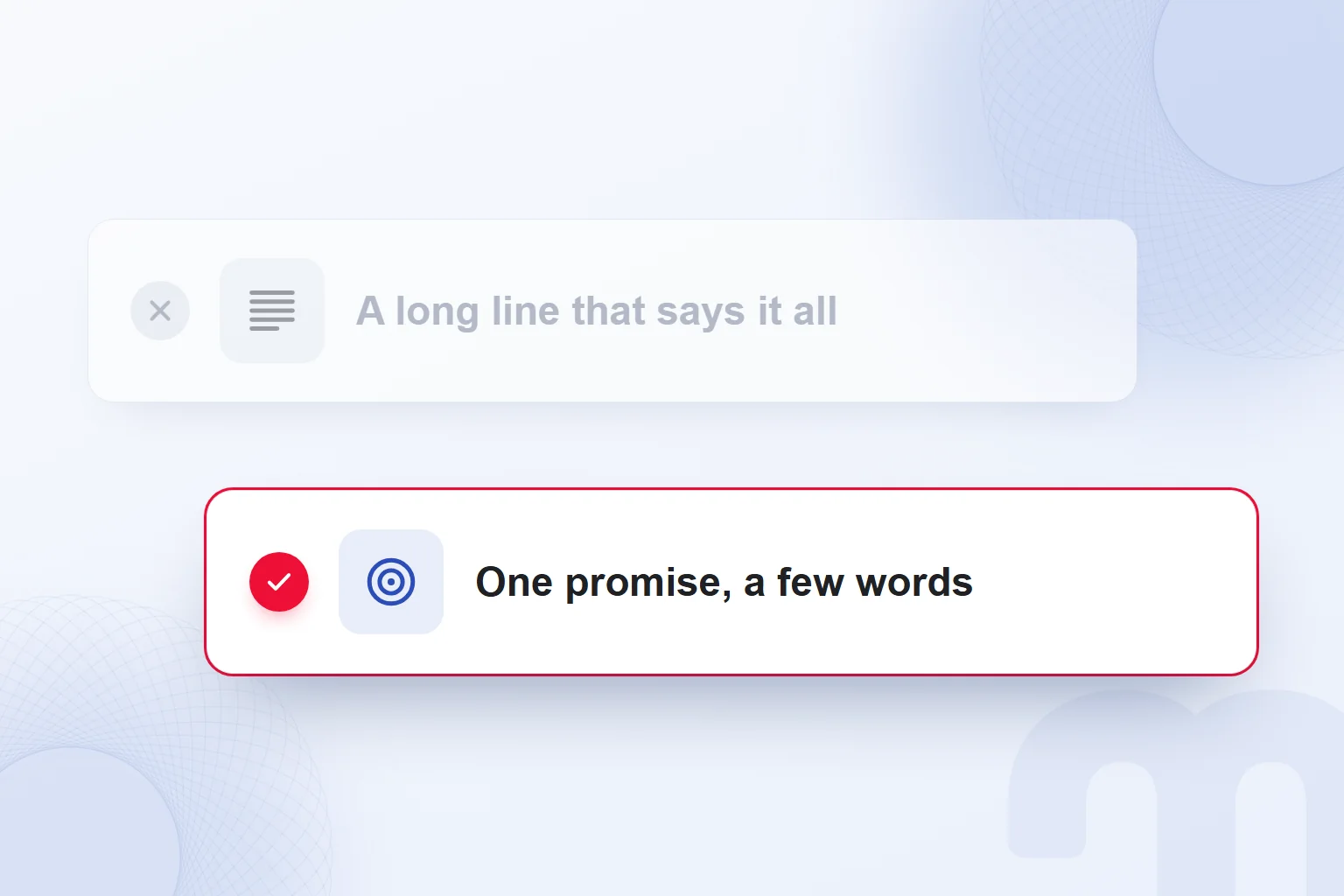
A good slogan is short, striking, easy to remember and repeatable, and it clearly carries one promise specific to the brand. Brevity, impact, memorability and repeatability come from the TDK definition. Choosing a single promise is our own method for weighing candidates.
If we describe an example bakery’s freshness, we do not add delivery, variety and price to the same line. If removing a word leaves the promise unchanged, we delete it; if the line needs a second sentence to explain it, we rebuild the meaning.
If the same phrase would fit very different businesses unchanged, we look for something sharper. We read the candidate aloud, fix where we stumble and ask a listener which promise they heard.
In Turkey, Article 7 of the Regulation on Commercial Advertising and Unfair Commercial Practices requires ads to be truthful and honest. A sentence that sounds good still has to be checked for truth; we assess every measurable claim alongside its supporting document.
For brevity we ask: does removing this word change what the customer understands? In “Fresh every morning”, dropping “morning” removes the time; dropping “every” changes the scope. Finding the fewest words and finding the right slogan are not the same decision. We keep words that carry meaning and cut only explanation.
“That sounds nice” is not enough. We note which product, benefit and expectation the reader took away. If an easy line suggests the wrong service, the meaning needs work; if a descriptive line drags aloud, we look for a plainer version. The choice then rests on concrete reasons, not taste.
How do you write a slogan?
We write a slogan by defining the brand’s promise and its reader, drafting several candidates, shortening and verifying them, and testing them where they will be used. The first candidate rests on a sentence describing the benefit the business really offers.
- We write the brand’s promise in one sentenceWe define the benefit offered to customers and choose the single idea the slogan will carry.
- We decide who we are talking toWe note the reader’s need and language, and choose words for that person.
- We draft several candidatesWe express the same promise in different patterns, trying calls, questions and rhythm separately.
- We read candidates aloud and shorten themWe fix what trips the tongue and remove words that do not change the meaning.
- We check claims against evidenceA measurable claim needs a document; we check each claim’s scope and basis together.
- We test the candidatesWe try the lines in an ad headline and a page title and judge whether they are understood and fit.
To define the reader, we use the framework from our buyer persona guide. If a stationery shop speaks to a parent doing back-to-school shopping, every line must answer that parent’s need.
We test candidates in ad headlines and page titles with an A/B test, deciding beforehand which behavior to assess and changing only the slogan, at the same type size. We record liking and understanding separately, note why the winner won and reuse those criteria later.
Writing a slogan, step by step: an example
Our example is a neighborhood bakery that we assume bakes bread every morning. The drafts show the method; they do not describe a real business’s production or advertising results.
- Draft: make the whole idea visible. “We deliver fresh bread, baked every morning in our neighborhood, to your breakfast table.” It covers the neighborhood, baking time, freshness and delivery at once. “Deliver” implies a delivery service, so in a scenario without one, it goes. The draft shows the limits of the promises.
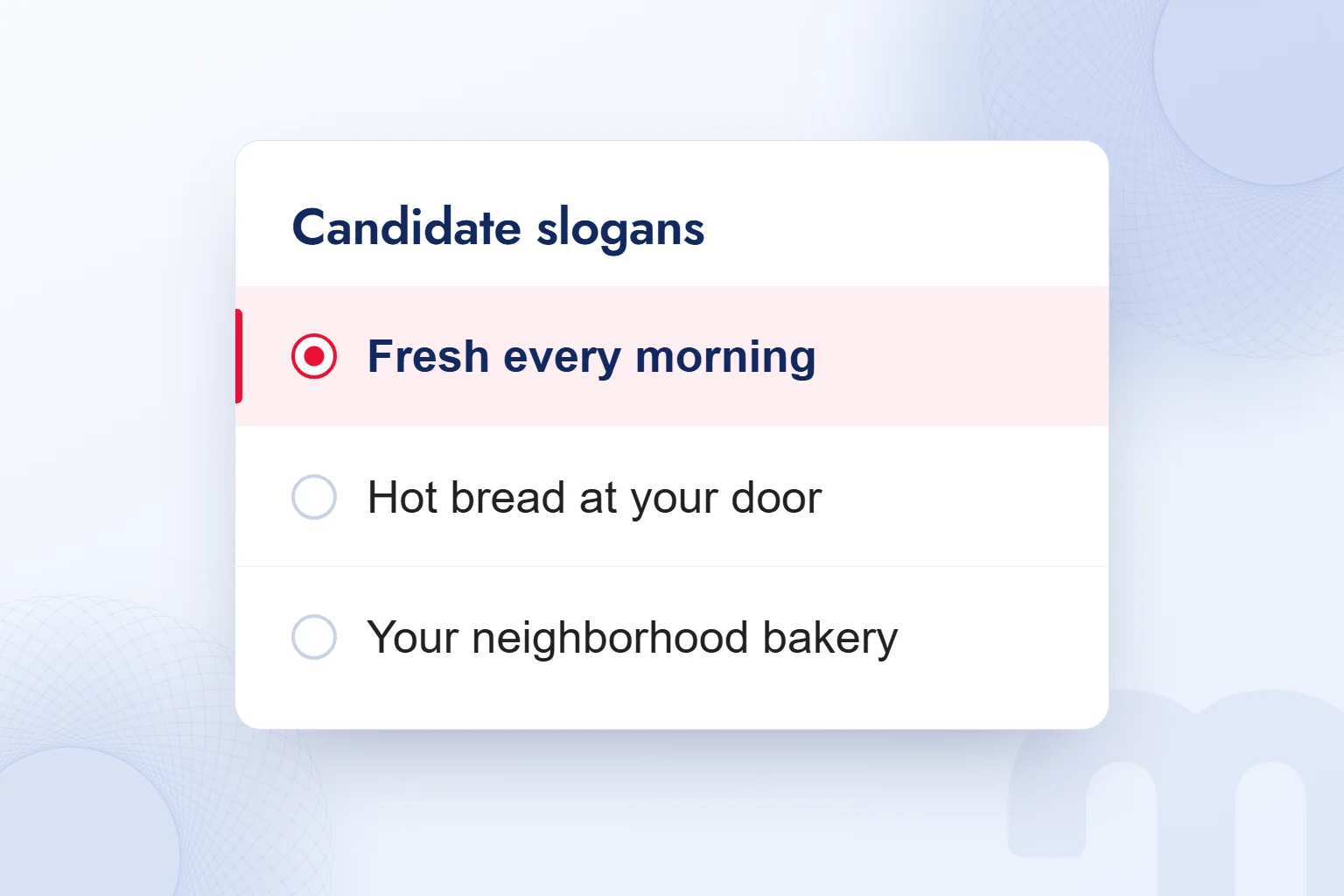
- Narrowing: decide on one benefit. “Fresh bread every morning” keeps morning baking and freshness together; the neighborhood and the breakfast table move to supporting copy. “Hot bread at your door” carries a different service promise, and “Your neighborhood bakery” a different emphasis. We compare the expectation each creates.
- Final version: read it in context. For a line shown with the bakery’s name and a picture of bread, we choose “Fresh every morning”. Where the product is not obvious, we reconsider the version that keeps “bread”. The final read checks the sound and whether the business can keep the promise.
The deciding reason is freshness; we did not require rhyme or a word count. Another business should write down what it actually does rather than copy this draft. Our notes keep the starting description, removed promises and final reason side by side for later edits.
Slogan examples: which patterns work?
We choose between promise, difference, call, question, rhythm and metaphor patterns according to the one idea the brand wants to say. We wrote the slogans below for example businesses and checked each against the service the business really offers.
- Promise: For a neighborhood bakery, “Fresh every morning”. The focus is freshness; we check that it matches the baking schedule.
- Difference: For a curtain workshop that measures on site, “Measured in your home”. We name how the business works without turning it into a claim of superiority.
- Call: For a cleaning company, “Leave us the key, we’ll do the rest”. We spell out the service scope separately so the slogan does not promise work the business does not do.
- Question: For a stationery shop, “What will your new notebook hold?” We tie the question to how the notebook is used, so the link to the product is not lost.
- Rhythm and the rule of three: For a ceramics studio, “Touch, shape, make”. Three actions gather around one making experience; we check the rhythm aloud.
- Metaphor: For a stationery shop, “Where ideas take root”. Metaphor transfers meaning; the image of taking root is linked to the birth of ideas.
The headline on our own home page follows this pattern: it brings search, discovery and AI answers together around a promise of visibility. Every part of the sentence supports that single promise.
For a direct benefit we work on a promise; for an invitation to act, a call. With questions and metaphors we check the link to the product with special care. Rhythm alone is not a reason to choose; words drifting towards different promises are rearranged around one message.
Short slogans: school and social topics
We wrote these examples for this article, tying each sentence to one message. None comes from a brand or campaign; they are writing examples for school posters and class projects. The table explains our word choices, not any measured success.
| Topic | Example slogan | Why it works |
|---|---|---|
| Environment | “Don’t drop it, bin it.” / “Make room for green, let your town breathe.” | The first sets the right action against the wrong one in two short verbs; the second describes green space in a single call. |
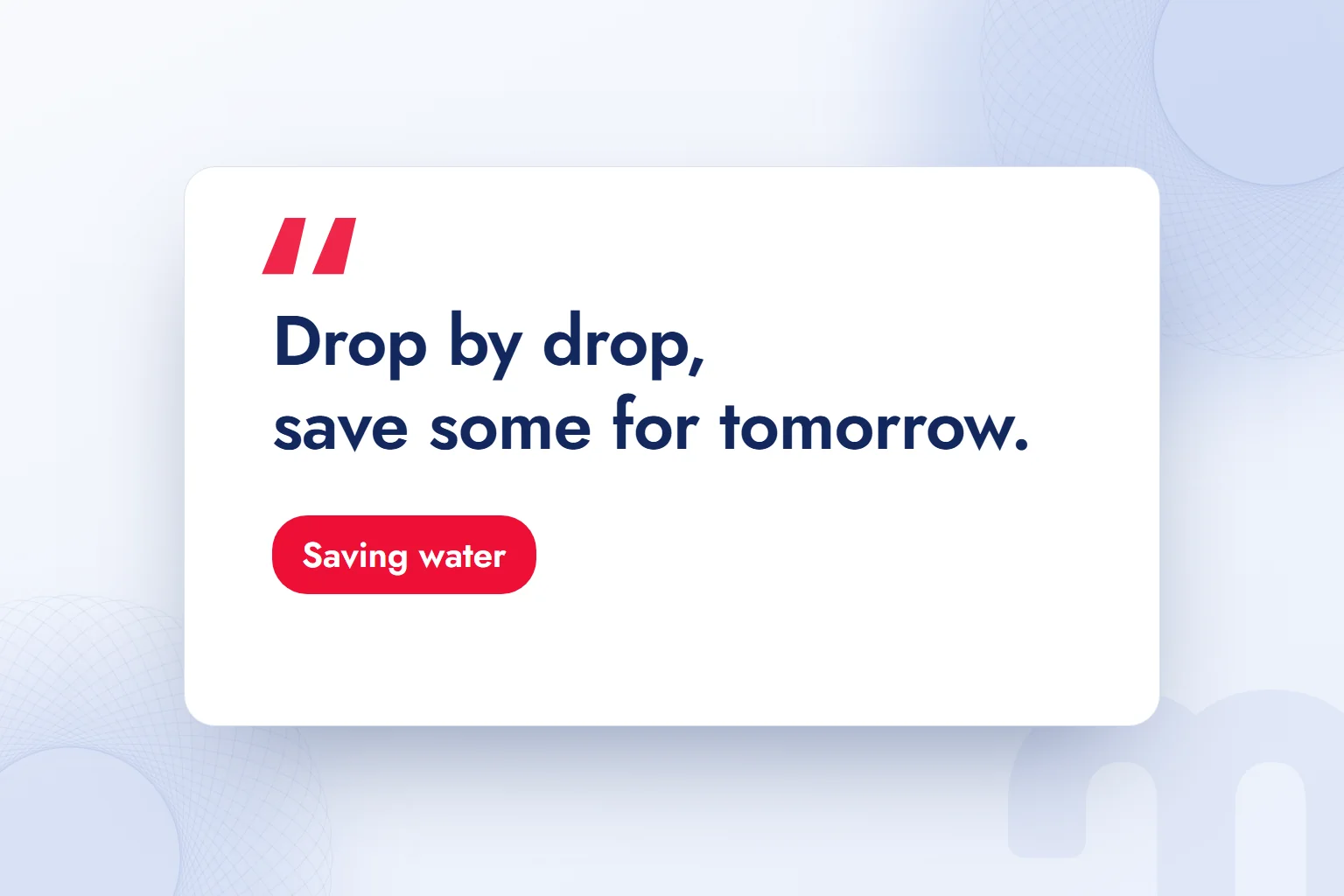
| Saving water | “Drop by drop, save some for tomorrow.” / “Turn off the tap, think of tomorrow.” | Repeating “drop” builds rhythm; both link today’s behavior to tomorrow. |
| Reading | “Open a page, meet a new idea.” / “Open your book, follow your curiosity.” | Joins concrete words such as page and book with ideas and curiosity. |
| Road safety | “Eyes on the road, care in every step.” / “Look first, then take your step.” | Keeps the call for attention and care short; does not promise a safety outcome. |
| Healthy eating | “Mind your meal, choose with care.” / “Think about your plate, pick your meal with care.” | Frames eating around choice and care; makes no health claim. |
Each line’s emphasis matches the poster’s topic: water, drop and tomorrow for saving water, not a book metaphor. For road safety we do not blur the behavior to make a rhyme, and we avoid adding “for our future” to every topic.
A short school slogan should not carry a long explanation; on a water poster, a sentence below it can explain the project. If the slogan only makes sense with that explanation, we rewrite it.
How do students write a slogan?
With students we work in this order: topic, one message, sound, reading aloud. In a primary or middle school project we avoid words the student cannot explain just because they look impressive; explaining their own sentence in their own words is our test.
- Choosing the topic: Under a broad heading such as the environment, we choose the poster’s idea. Not dropping litter and protecting green space are separate messages.
- Writing one message: We put the idea into a plain sentence, then shorten it while keeping the meaning. We do not add another topic to the line.
- Trying the sound: We try different words for repetition or rhyme. A repetition such as “drop by drop” stays if it supports the meaning and goes if it makes the line harder to follow.
- Reading aloud: We read the sentence aloud and listen to what a classmate understood. We fix where we stumble and read the final version again on the poster.
How do you use a slogan in ads and on your website?
We fit the slogan into the ad headline and use the same line consistently in the site title and social media bio. The first check is the limit of the space where it will appear.
According to Google Ads Help, the system tests headline and description combinations over time and learns which perform better. A headline can be to Headline position 1. When we want the slogan there, we consider that pinning option.
We check the character limit and the promise’s clarity together. A line that does not fit is never cut at random; we write a shorter candidate that keeps the meaning.
On the website, copy next to the slogan explains the service; in a social media bio we keep the line and shorten what surrounds it. Before publishing, we compare all three side by side.
Is a slogan legally protected, and what about the claims in it?
We assess trademark protection for a slogan against the condition of distinctiveness, and we document the truth of the claims we use in ads. In Turkey, the trademark definition of the Turkish Patent and Trademark Office (TURKPATENT) rests on distinguishing one business’s goods or services from those of others.
The definition lists seven types of sign: words, figures, colors, letters, numbers, sounds and the shape of goods or their packaging. To protect a slogan, we assess with a whether the phrase meets this distinctiveness condition. We never infer a registration outcome from a phrase being short.
Under Article 9 of the same Turkish regulation, advertisers must prove the claims in their ads. Its second paragraph requires descriptions, claims and illustrations about verifiable facts to be backed by scientifically valid information and documents, and a measurable statement in a slogan falls under this check.
The next step depends on the situation:
- The claim is measurable and we have evidence → we check that the line stays within the document’s scope and keep the document.
- The claim is measurable but we have no evidence → we remove the claim from the slogan, or measure and document it first.
- The slogan resembles another brand’s line → we do not use it and look for a new, distinctive phrase.
We check that what was measured and what is promised are the same thing, and record the distinctiveness assessment and the claim’s basis separately.
How do you register a slogan as a trademark, and how do you search for one?
To register a slogan, we recommend a search for similar marks before applying, then an assessment of whether the phrase meets the conditions for a trademark. In Turkey, Article 4 of Industrial Property Law No. 6769 requires a sign to distinguish one business’s goods or services from others and to be capable of being shown in the register. The article covers words, including personal names. A slogan looking short or original does not mean it meets these conditions.
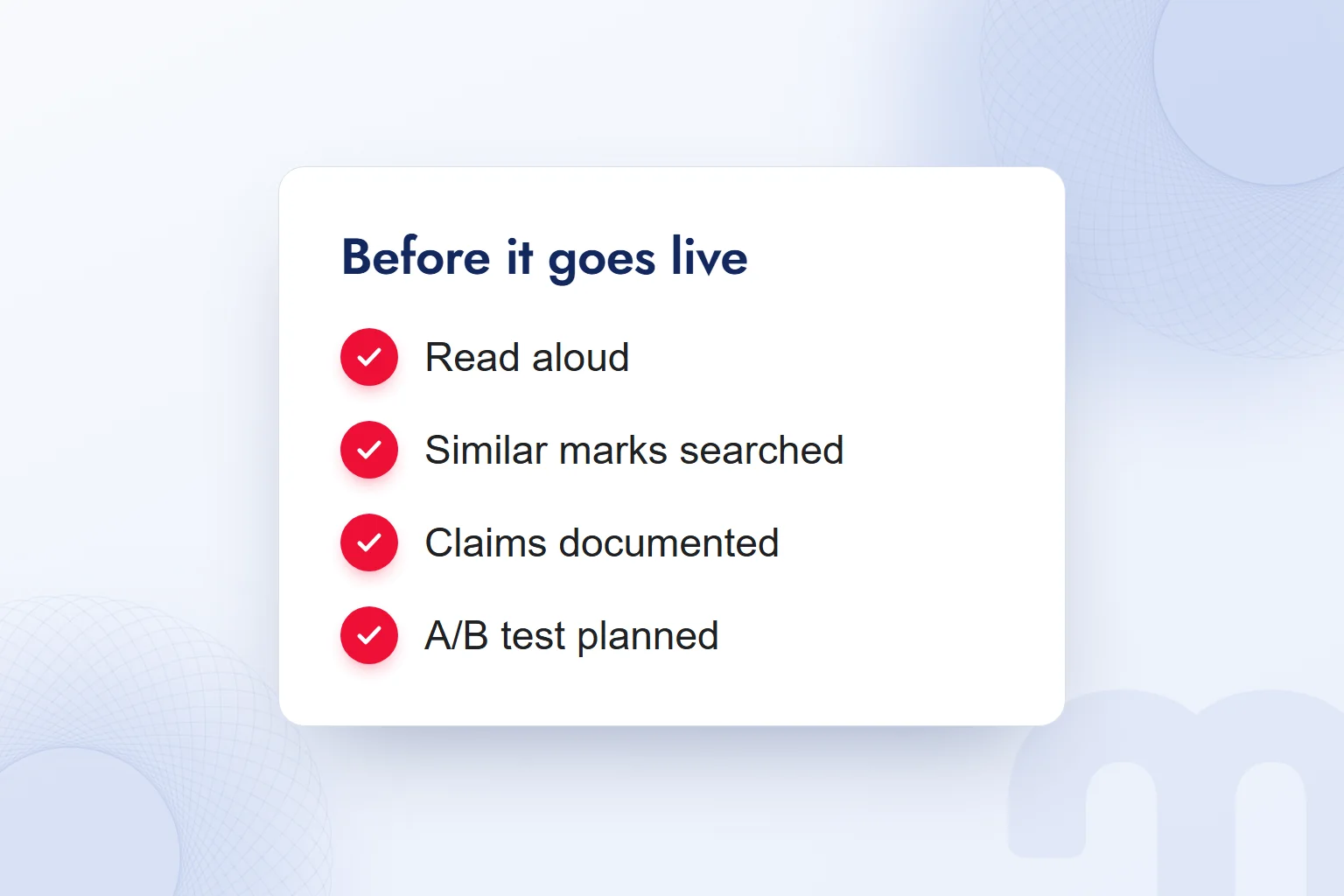
We note the exact wording and the goods or services it will be used for, and search every candidate, not only the first one we liked.
For a slogan trademark search, we search TURKPATENT for the full sentence, its distinctive words and close spellings, recording similar phrases with the goods or services examined. This is preparation; we never read the absence of an identical phrase as a guarantee of registration. When we see a similarity, we discuss changing the candidate with a trademark attorney.
The office decides whether a mark is registered. Writing a slogan, filing an application and holding a registered trademark are different states, and the usage plan says which one applies.
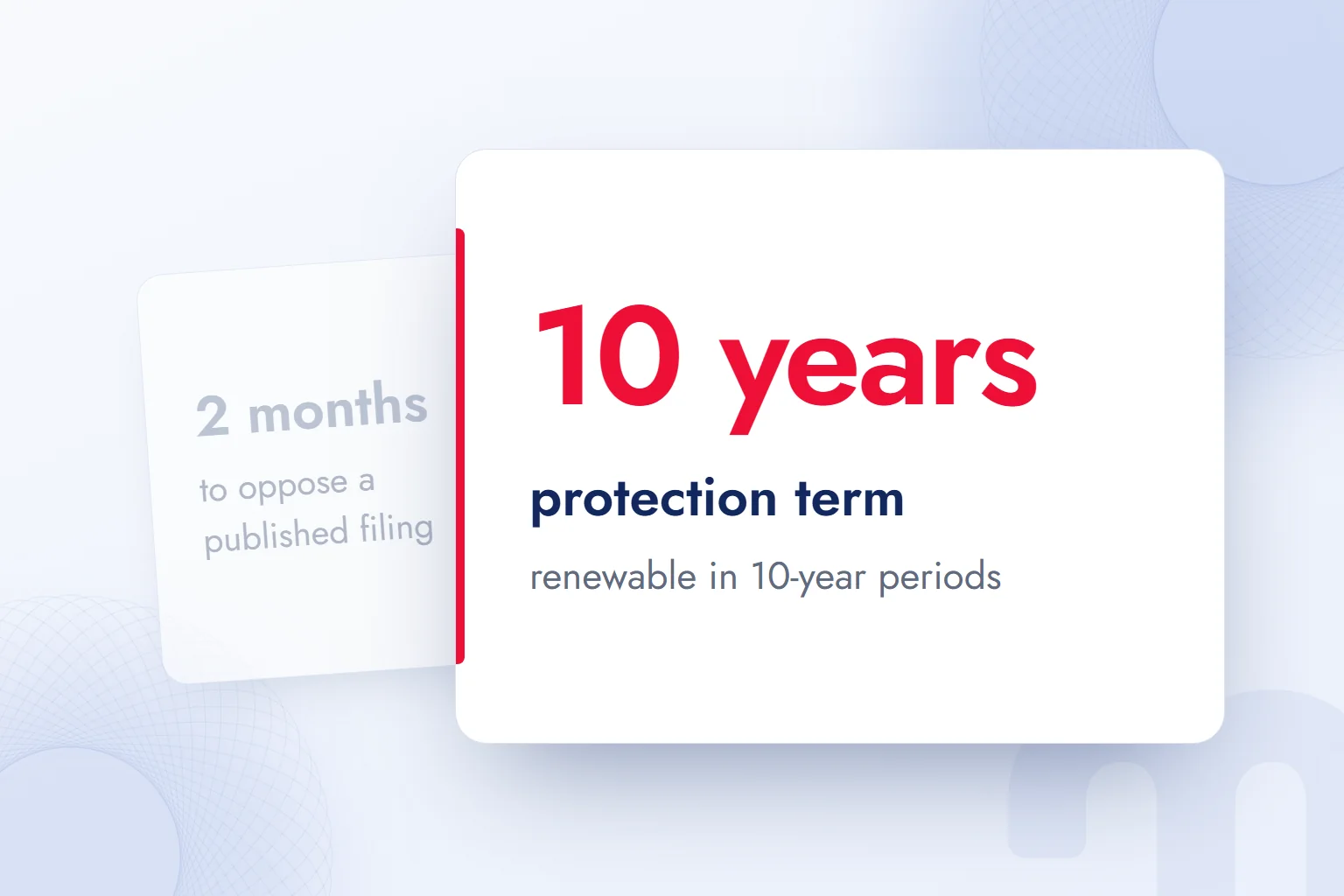
Under Article 23, the ten-year term starts from the filing date and is renewed in ten-year periods; for renewal we track the six months before the term ends. The two-month opposition period in Article 18 runs from the application’s publication in the bulletin. The two periods cover different procedures: one protects a registered mark, the other concerns opposing a published application.
When should you change a slogan?
We reassess a slogan when it no longer describes the brand’s scope, when its information is no longer true, or when the audience forgets or misreads it. We write down the reason for the change first.
Three common situations, and what each calls for:
- The brand has expanded into a new service area → we check whether the slogan still describes the whole brand.
- The information in the slogan is no longer true → we update it, as the principle of truthfulness requires.
- The audience forgets or misreads the slogan → we test new candidates with the same method.
We identify which part of the old line caused the problem; shortening the wording and changing the promise are separate decisions. Once a new line is chosen, we check the site title, ads and social media bio so the retired line does not linger.
The final read also covers how the slogan works alongside the logo. More of our writing on brand language, advertising and content is in our digital marketing articles.
This term is part of our digital marketing glossary. You can reach the one-sentence definitions of the other terms there.
Frequently asked questions
What does slogan mean?
A slogan expresses an idea or a brand in short, striking words that are easy to remember and repeat. The TDK dictionary also gives the sense of a saying that sums up an organization’s aims.
What is the difference between a slogan and a tagline?
A slogan promotes an idea or a product; a tagline is a short signature line that makes a company or its products recognizable. The intended use of the phrase decides which it is.
What is a motto?
A motto is a short phrase that expresses the belief, aim or principles of a person or organization. The TDK dictionary pairs it with the maxim.
How do you write a slogan?
We define the promise and the reader, draft different candidates, read them aloud and shorten them. We check claims against evidence and test candidates in ad headlines and page titles.
Can a slogan be a trademark?
TURKPATENT’s trademark definition covers words and rests on distinguishing goods or services from those of other businesses. We assess a slogan’s distinctiveness and protection with a trademark attorney.
How many characters can a slogan in an ad headline have?
In a Google Ads responsive search ad, a headline allows up to 30 characters. When a slogan goes there, we keep it within the limit without losing the promise.
What are some short slogan examples?
Our own “Drop by drop, save some for tomorrow.” is for saving water, and “Open your book, follow your curiosity.” for reading. Each keeps one topic and a clear message.
Can you register a slogan?
It depends on the trademark conditions, including distinctiveness, and the office decides. Before filing in Turkey, we recommend a similar-mark search at TURKPATENT, reviewed with a trademark attorney.
 How to make a presentation: AI tools, PowerPoint and proposal decksRead article
 How to make money on Instagram: eligibility requirements and toolsRead article
 What is Pantone? Color palettes, color codes and brand colorsRead article
 What is a SWOT analysis? How to do one, and how it differs from PESTRead article
 What is a case study? How to write a client case study, with templateRead article
 What is a blog, and what is a blogger? How to write a blog postRead article
 Instagram post size: square, portrait, story and Reels dimensionsRead articleMost read
 What is a hashtag? How to use hashtags and how many to addRead article
Questions & answers
0 commentsNo questions yet; you can ask the first one.